By Jiale Xiang and Boyuan Zhang.
The History and Capabilities of STFC Hartree Centre
Named after physicist Douglas R. Hartree, a pioneer in numerical methods, the STFC Hartree Centre has grown into a major computational hub. Supported by over £170 million in funding, it hosts advanced computing systems—including the Bull Sequana X1000 and earlier platforms like Blue Joule—and collaborates with major industry partners such as IBM and Nvidia. These resources enable research in fields ranging from engineering and health to materials and climate science.
Located at Sci-Tech Daresbury, the Centre is also one of the UK’s leading hubs for high-performance computing (HPC), artificial intelligence (AI), and quantum technologies. Its aim is to support UK businesses and researchers in harnessing the power of advanced digital tools, using supercomputers, AI, VR, and quantum computing, to tackle real-world challenges.
As early-stage researchers, our visit was designed to bridge the gap between academic study and industry innovation. It gave us a chance to see how the technologies we’re exploring at N0MES are applied in real-world contexts and presented a fantastic opportunity to discover potential areas for collaboration.
Hartree Centre Training Portal
The Training Portal offers a free, beginner-friendly online platform that lowers the barrier to entry for those new to computational methods. It offers modular training in; Data Science, AI and Modelling, HPC and Exascale Computing, Software Engineering and Emerging Technologies. The portal exemplifies the Centre’s commitment to inclusive, skills-focused digital education.
Virtual Reality in Scientific Communication
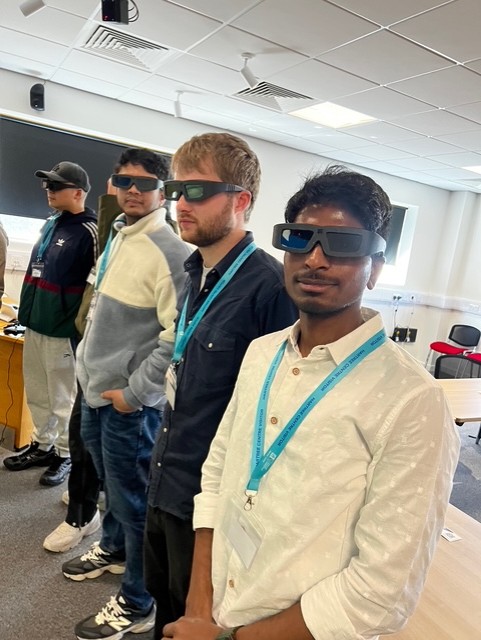
This tour provided a striking interactive VR model of the COVID-19 spike protein, which illustrated how immersive technologies can enhance public understanding of complex scientific concepts. It was a compelling example of how VR can transform education and outreach.
Fluid Simulation Showcase
The fluid dynamics simulation shows coloured fluids merged in realistic patterns. This visually engaging display highlighted the accuracy and versatility of HPC in modelling physical phenomena. Such simulations have clear relevance to industry and research alike.
The Visit
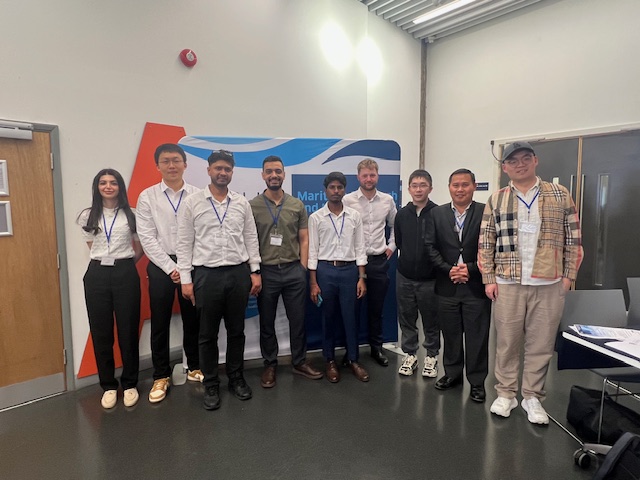
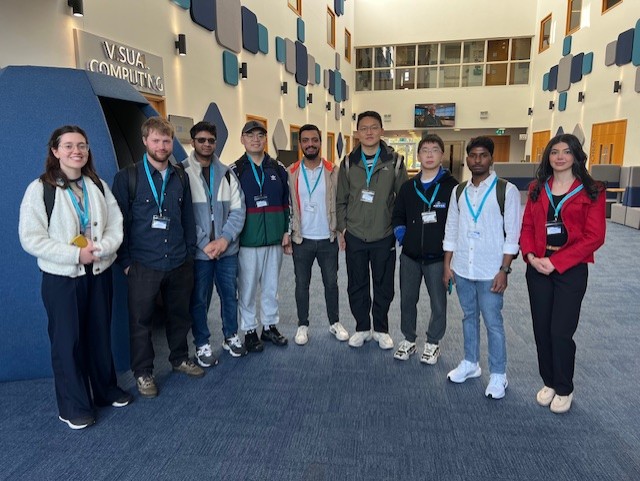
On April 8th, 2025, we had the privilege of visiting the centre as part of a research cohort. Our CDT focuses on maritime energy generation, distribution, and environmental impact.
We arrived at the STFC Hartree Centre with great anticipation. Upon arrival, we were welcomed and then began the visit with an overview presentation on the Centre’s work, covering topics like trustworthy AI, digital twins, AI for materials science, and sustainable computing. We learned about the Centre’s vision, current research projects, and the technologies they are using, including impressive applications of AI and virtual reality (VR). But it wasn’t just a series of talks, we also had engaging discussions with Hartree researchers who are at the cutting edge of digital innovation. They shared valuable insights into their online courses and training programmes, where we can access sessions on data science, AI, and modelling, a great resource for developing our research skills further. Later, we were shown how they apply VR technologies in healthcare and transport research. This cross-sectoral approach really highlighted the importance of interdisciplinary collaboration in addressing some of society’s biggest challenges.
Reflections and Takeaways
Visiting the Hartree Centre gave us a fresh perspective on how academic research can drive meaningful impact in industry. It was exciting to see how the work at N0MES aligns with national digital priorities and to imagine the potential for future collaboration.
Boyuan says “The Hartree Centre visit offered more than a tour—it provided insight into how cutting-edge computing can intersect with accessible education and industrial impact. From free training resources to immersive science communication and applied simulation, the Centre exemplifies how advanced technologies can be democratised and translated into real-world value. This visit reaffirmed the importance of open access to digital tools and the role of research centres in enabling innovation far beyond academic labs.”
Jiale says “The visit left a deep impression on us. It emphasised how tightly connected academic research is becoming with real-world applications and industry needs. It also sparked new ideas for our PhD projects and encouraged us to think more deeply about how our research could align with or contribute to initiatives like those at Hartree. This visit wasn’t just a field trip—it was a glimpse into the future of research, innovation, and collaboration. Thank you to everyone at the Hartree Centre for such a warm welcome and for sharing your inspiring work with us!”